
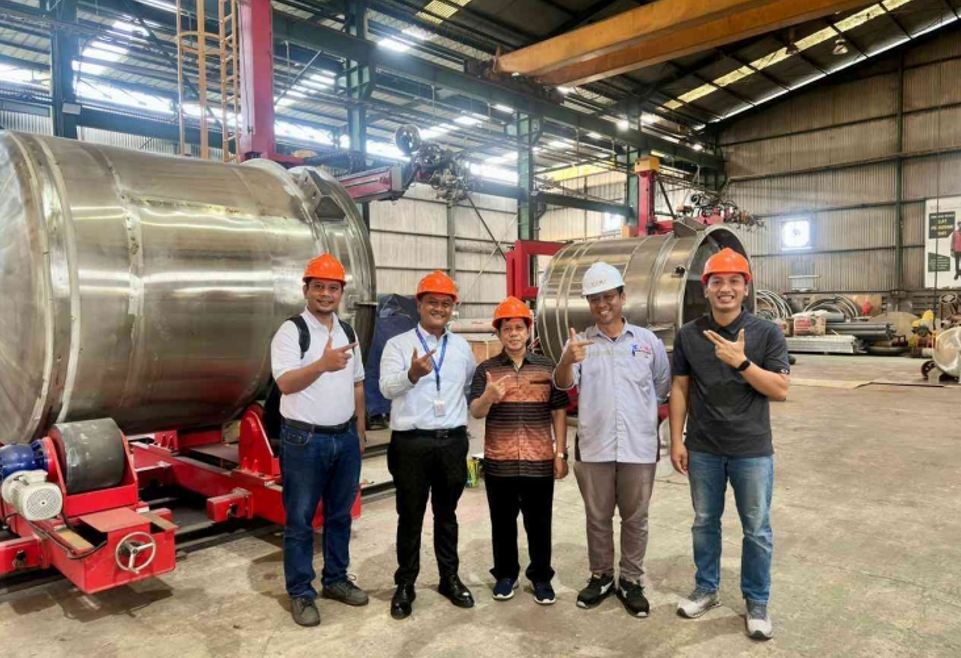
The Industrial Chemical Engineering Technology (TRKI) Study Program of the Vocational School at Diponegoro University has once again demonstrated its contribution to the development of Indonesia’s chemical industry through its involvement in the design study of a nitric acid plant being developed by PT Sabatani Global Solusindo (PT SGS). The academic team, consisting of Mohamad Endy Julianto, Hermawan Dwi Ariyanto, and Yusuf Ma’rifat Fajar Azis, served as advisors in discussions regarding the technical aspects and process technology selection for the proposed facility.
During discussions with the President Director of PT SGS, Paustinus Gunarto, one of the primary focuses of the study was increasing nitric acid purity from its azeotropic concentration of approximately 68% to more than 90%. This challenge represents a significant issue in the nitric acid industry due to the limitations of conventional distillation processes in separating mixtures at the azeotropic point.
Various technological alternatives were evaluated to achieve the targeted purity level. One of the most promising approaches involved membrane-based technologies, including pervaporation, vapor permeation, and membrane distillation. These technologies offer the potential to improve separation efficiency through the membrane’s ability to selectively remove water from nitric acid solutions.
In addition to membrane technologies, the team also examined hybrid process concepts that combine conventional distillation with membrane separation units. Through this approach, nitric acid solutions obtained from the distillation process can be further purified using membrane systems to achieve higher purity levels while reducing overall energy consumption.
Nevertheless, the study also considered several practical implementation challenges, including membrane resistance to the highly oxidizing nature of nitric acid, fouling potential, membrane lifespan, and economic feasibility at an industrial scale. Therefore, technology evaluation was conducted not only based on technical performance but also on safety, sustainability, and investment feasibility considerations.
The study concluded that extractive distillation remains the most widely applied technology in large-scale nitric acid production due to its proven reliability. On the other hand, the use of salts such as magnesium nitrate was identified as an attractive alternative because of its potential for improved energy efficiency. Meanwhile, azeotropic distillation was considered less suitable for large-scale industrial applications due to its greater operational and safety challenges.
The involvement of TRKI Vocational School UNDIP in this project highlights the active role of vocational higher education institutions in supporting technology-driven industrial development and innovation. Through collaboration with industry partners, TRKI contributes not only to education and research but also to the development of practical engineering solutions that support a more advanced, efficient, and competitive national chemical industry.