
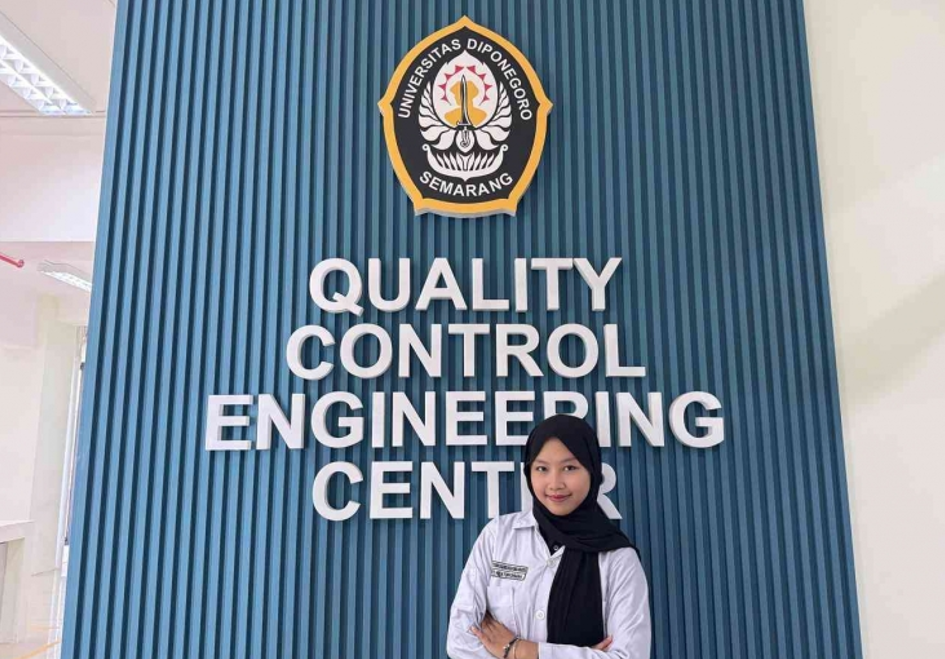
The advancement of technology and the growing demand for sustainable industrial practices encourage students not only to understand engineering concepts but also to develop solutions that address real industrial needs. This commitment is demonstrated by Siti Hibatirrohmah, a student of the Applied Bachelor’s Program in Industrial Chemical Engineering Technology (TRKI) at the Vocational School of Diponegoro University, through her research focusing on the valorization of biodiesel by-products into value-added products.
Siti Hibatirrohmah is a graduate of SMA Negeri 1 Batang who actively participated in various academic and organizational activities throughout her studies. On campus, she was involved in the Vocational School Student Executive Board (BEM SV) as a member of the Media and Information Bureau and served as the Head of the Redaction Division. She also actively contributed to the Industrial Chemical Engineering Technology Student Association in the Research and Development Division as well as the Student Welfare Division.
In her final-year research project, Hibat investigated the purification of glycerol, one of the major by-products of the biodiesel industry, using ultrafiltration membrane technology. The study aimed to improve glycerol quality so that it could be utilized as a raw material for environmentally friendly biocoolants, offering a greener alternative to conventional synthetic cooling agents.
The research was conducted under the supervision of Mohamad Endy Julianto, S.T., M.T., and focused on removing contaminants such as methanol and free fatty acids from glycerol using a membrane-based separation system. Through this approach, the study sought to obtain glycerol with higher purity, thereby expanding its potential industrial applications.
Beyond the separation process itself, the research also highlights opportunities for integrating data-driven technologies and Artificial Intelligence (AI) into process optimization. AI has the potential to monitor operating parameters in real time, predict membrane performance, and determine optimal operating conditions to enhance purification efficiency.
Through this research, Hibat aims to achieve a glycerol purity level of up to 93.7 percent. This result demonstrates the potential of biodiesel waste utilization as an alternative raw material with higher economic value while supporting the principles of the circular economy and sustainable industrial development.
In addition to her technical expertise in process engineering, Hibat possesses strong skills in digital technology applications, including data processing, visual communication design, and digital media management. The combination of technical competence, research capability, and digital skills provides valuable preparation for meeting the demands of increasingly technology-integrated industries.
Through her research, Siti Hibatirrohmah demonstrates how vocational education students can contribute to the development of applied technologies that support sustainable industries. Transforming waste into higher-value products not only generates economic benefits but also promotes more efficient and environmentally responsible resource management.